
MONUMENT TO A SOLDIER: John D. Vaughan
Part two of two: By Mary Beth Litrico
John D. Vaughan entrenched himself as a planter at his Amelia Island plantation after serving his country in the War of 1812. His large plantation required the work of over 500 slaves. Family documents state this number comes from "authentic records," but census records taken in the area around this time list smaller numbers. This discrepancy is noted in part one of this story.
Regardless, Mr. Vaughan would acquire even more land in the form of a Spanish Land Grant. Located off the island, a plat of 950 acres at Lofton Creek on the Nassau River was certified by Jorge G. F. Clarke for J. D. Vaughan in December of 1816. Though in 1824, records show Mr. Clarke still making depositions in behalf of his employer for this land. The volatile governments (Spanish, United States, Patriots, MacGregor and Luis Aury) in power from 1812 to 1821 must have made record keeping difficult. In fact, the total amount of land John Vaughan owned is unknown, due to poorly kept records. Records for 1200 Spanish Land Grant acres mentioned in this story can be found in the Florida State Archives.
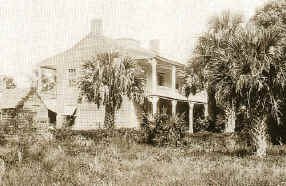
(Photo courtesy of David and Iris Jacobsen)
John D. Vaughan also received land from the government of the United States for his military service. On June 4, 1833, claiming to be "seventy" years old (Mr. Vaughan had claimed to be two years older to enlist at only 14 years of age), he appeared before a Justice of the Peace in Washington, D.C. desiring to receive the bounty land "promised" him by the United States for his Revolutionary service. Then in March of 1856 when he was "ninety-three" years old, he made known his desire to receive a bounty land warrant for his service during the Indian War before a Justice of the Peace in Nassau County.
Although the warrant records 100 acres, the location is not mentioned. Still, 100 more acres of free land is a desirable asset.
This gentleman yankee planter also played a part in our local history. In 1823, John D. Vaughan and his wife, Rhoda, were involved in the first civil court case in Duval County. (Nassau County was a part of Duval at the time.) The Vaughans were defendants in a case versus Ephriam Harrison. Mr. Harrison sued the Vaughans over the death of a mare and foal which trespassed on the Vaughan property. A neighbor, Mr. Suarez,
searched the Vaughan's slave quarters and found possible evidence, a bayonet and a rusty sword. He then apparently threatened a confession out of one of the slaves, and the jury did find the Vaughans guilty of Mr. Harrison's civil charges. Compensation was made.
A vast plantation such as the Old Nest, (or Mount Hope, as listed in official records), had plenty of room and economy for raising children. Three are listed in John D. Vaughan's last will and testament: Daniel Vaughan, his oldest son, William Vaughan, his second and youngest son and Jane Pharaba Cooper, his only daughter.
In the last years of his life, John D. Vaughan would gain land, but lose a child. Daniel Vaughan, born in 1800, died while his father was still alive in 1856. He spent his life at Mount Hope and managed it for several years before his accidental death during a steamboat explosion off of St. Simon's Island, Georgia. Daniel's portion of Mr. Vaughan's will went to his widow, Eliza Vaughan. He is buried in the Vaughan plot where the obelisk stands.
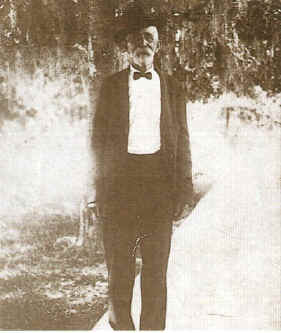
John D. Vaughan's determination to fight for liberty and against tyranny continued in his grandchildren. John James Vaughan, son of Daniel, was born in September of 1835. Like two of his brothers, Horace Daniel and Franklin Decatur, he would serve the Confederate States of America in the First Florida Regiment. Though John James would survive, his brothers did not. John James must have been carrying all the Vaughan luck, as he not only survived attack, he survived being wounded nine times. According to family history, he went to Cuba after the Civil War to serve in the ten years rebellion there. He died in Florida in 1914.
Not only did John D. Vaughan suffer the loss of a child, he also suffered widowhood. That this yankee soldier loved his southern lady and the beautiful land of his plantation is confirmed by recollections of his great-great-granddaughter. Mary Vaughan Scott, only eleven years old at the time of his death, remembered that her beloved great-great-grandfather would be carried to the river "in the arms of his faithful slaves where he would sit and fish for hours." Ms. Scott recollected another personal time of her beloved ancestor's.
His last request was that he be buried in the same grave with his beloved wife who had preceded him in death many years.
ALMOST THE LAST OF THE
HEROES OF THE REVOLUTION,
HIS LIFE FADED CALMLY. IT
WAS MARKED BY ALL THOSE
VIRTUES WHICH ADORN A HERO,
EVENTFUL AND DETERMINED.
HE LIVED RESPECTED.
HE DIED BELOVED.
-West side of monument
Printed notes indicate this part of the obelisk's etched epitaph was signed "Rhoda, His Wife," though other research states she died before her husband. Furthermore, the fact that he left nothing to Rhoda in his last will and testament confirms she died before he did.
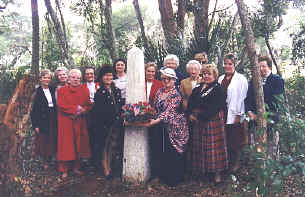
Though dead for over a century, John D. Vaughan was still honored by his family and patriotic organizations. On May 8, 1927, the Florida Times-Union reported a tribute to John D. Vaughan for his military service. Four generations of his family were in attendance, including Mary Vaughan Scott, as well as National Daughters of 1812, State of Florida, Boy Scouts, Girl Scouts and 79 year-old Charles G. Mann, the only living veteran of the Civil War on Amelia Island. Following an opening address and unveiling of a marker by the obelisk, Mrs. Hugh J. McCallum, a relative, read a sketch of John D. Vaughan's life. Over 70 years later, the Amelia Island chapter of the DAR paid a similar tribute to this respected man. On January 26, 2000, after a DAR gathering in Fernandina Beach, members laid a wreath to honor the Revolutionary soldier's grave. This same chapter sponsored an historical marker downtown that commemorates Revolutionary battle on Amelia Island. After two centuries John D. Vaughan is not forgotten. May it ever be.
WHEN IN COMING YEARS THE
STRANGER SHALL READ THIS
EPITAPH, REMEMBER THAT
THIS MONUMENT MARKS THE
SPOT OF ONE WHO LIVED IN
TIMES WHICH TRIED MEN’S
SOULS, AND THAT HE ASSISTED
IN BEQUEATHING TO YOU THE
RICH LEGACY YOU NOW ENJOY.
SACRED BE THE SPOT.
-South side of monument